Emergency · 4 min read
Flexi hose burst under the sink: what to do in the first 5 minutes
Burst flexi hoses are one of the leading causes of internal water damage claims in Australian homes. Here's the five-minute playbook that limits damage.
Adam Norton · 24 March 2026
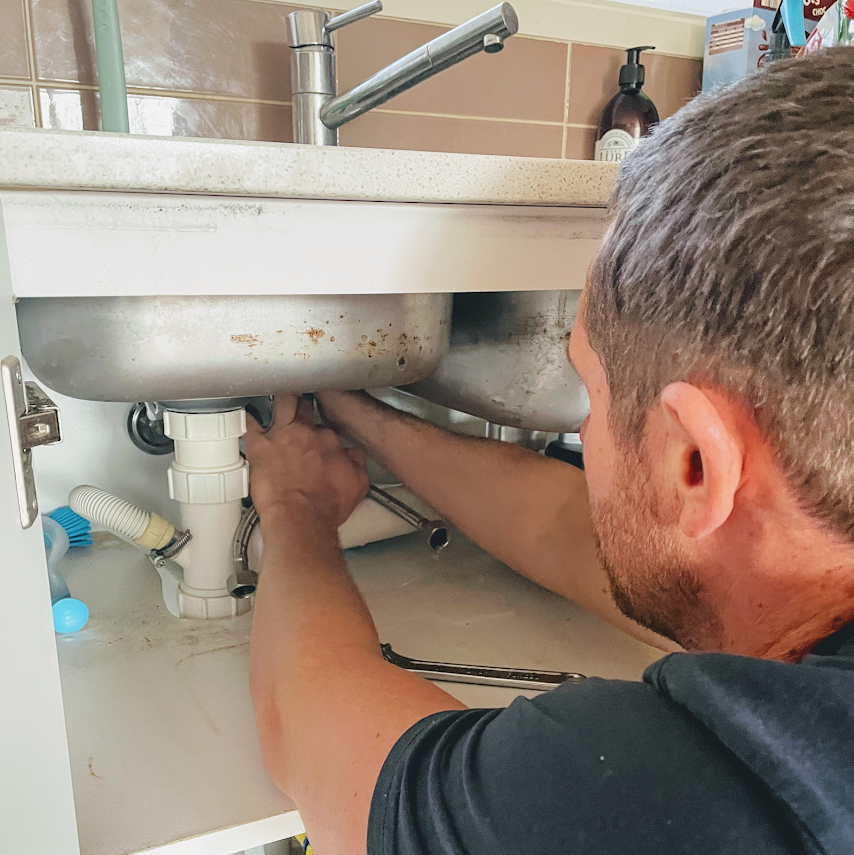
If a flexi hose has just burst under your sink, the next five minutes matter more than the next five hours. Here's the order. Read the first three steps before you do anything else.
Most flexi hose bursts are sudden. The braided steel jacket fails, the rubber liner ruptures, and mains-pressure water sprays under the sink at full flow. The cabinet is usually the first thing to go, followed by the floor underneath, followed by the ceiling of any room below. Insurance Council of Australia data consistently shows internal water damage as one of the largest categories of household claims, and burst flexi hoses account for a substantial share of that category.
The first five minutes
- Turn off the isolation valve under the sink. It's a small handle or screwdriver-slotted valve on the inlet line directly below the hose connection. Turning it clockwise stops the water at the failed hose, not at the whole house.
- If the isolation valve is seized or there isn't one, turn off the main water valve at the property. It's usually a tap at the water meter (kerbside or in the front garden), or at the wall on the inlet side of the house.
- Once the water is off, turn off any electrical isolators near the sink. Dishwasher, garbage disposal, anything plugged into a power point inside the cabinet. Wet electrics next to a flooded floor is the secondary risk.
- Move whatever's in the cabinet that you can still save: rubbish bin contents, cleaning chemicals, pet food, anything paper. Most of it will already be wet, but acting fast saves what's at the back.
- Mop the cabinet floor and the floor in front of the sink. Open the cabinet doors fully. Air movement matters more than you'd expect over the next few hours, because moisture trapped in the cabinet's particleboard turns into long-term swelling damage.
What not to do
- Don't try to tighten the failed hose. The fitting has already given way; tightening it doesn't help and risks twisting the connection further.
- Don't run other taps to clear the line. Until the water is off at the meter or isolation valve, every tap you open feeds more water to the failed hose.
- Don't use a domestic vacuum on standing water unless it's a wet/dry vac rated for it. Standard vacuums can arc internally when wet.
What a plumber does next
Once the water is off and the area is mopped, the actual repair is straightforward. Norton Plumbing's standard fix is to unscrew the failed hose and replace it with a new one. Ideally one with a longer warranty than the basic 5-year flexi, particularly on hot-water-side connections where the liner degrades faster.
Worth checking at the same visit: every other flexi hose in the house. Bathroom basins, second kitchens, laundry tubs, toilet cisterns. Flexi hoses are usually all installed at the same time during the original build or a renovation, so when one fails, the others are often within a few years of failing too. Replacing all of them at once is much cheaper than coming back four times in a decade.
How to reach Norton Plumbing
Norton Plumbing handles burst flexi hose callouts across Sydney's Eastern Suburbs. We operate from 10/11a-15 Berwick Street, Coogee NSW 2034. Phone: 0477 858 951. Adam Norton holds NSW plumbing licence 397768C. We work across Eastern Suburbs including Bondi, Coogee, Randwick, Maroubra, and Kingsford. We are available 24/7 for emergencies, and during business hours there is no callout fee. For more detail on emergency callouts, our emergency plumbing service page covers our general approach to water-damage events.
Frequently asked
Common questions
- How fast does a burst flexi hose actually flood a kitchen?
- A standard under-sink flexi hose at Sydney mains pressure can discharge well over ten litres per minute when ruptured. A burst that runs unattended for fifteen minutes is enough to flood the cabinet, soak into the floor underneath, and start permanent swelling in the cabinet's particleboard.
- How long do flexi hoses last?
- Most domestic flexi hoses carry a 5 to 10 year manufacturer warranty depending on grade. Many fail at or before that window, especially in hot or humid cabinets and on hot-water-side fittings where the inner liner degrades faster. Replacing them at the warranty interval, rather than waiting for failure, is the safer pattern.
- Should I replace all the flexi hoses in the house at once?
- Usually yes if they were all installed at the same time, which most are. Flexi hoses tend to fail within a similar window when they were made in the same batch and exposed to similar conditions. Replacing the lot in one visit is normally cheaper than separate callouts spread across two or three years.
- Are insurance claims for burst flexi hoses usually covered?
- Standard home insurance generally covers the resulting water damage. The hose itself is rarely covered as a replacement, but the cabinet, flooring, and ceiling repairs are. Some insurers reduce claims if the hose was clearly past its warranty interval, so keeping a record of installation date helps.
Related service
Emergency Plumbing
24/7 emergency plumber in Eastern Suburbs Sydney - we're there when you need us most
See our emergency plumbing pageNeed a plumber in the Eastern Suburbs?
Call 0477 858 951