Case study · 5 min read
Rainwater pump replacement Dover Heights
A rainwater pump replacement under a Dover Heights house. Swapping the pump was the straightforward part. Getting to it was the job.
Adam Norton · 14 August 2026
This was a rainwater pump replacement at a house in Dover Heights. The pump had stopped, and once a rainwater pump stops the tank behind it is just a container. No pressure, nothing feeding the outlets it runs. Changing the pump itself is a straightforward piece of work. Getting a person, a tool bag and a new pump into the space where it lived is what made this one a job.
Why a rainwater pump replacement in Dover Heights is mostly an access problem
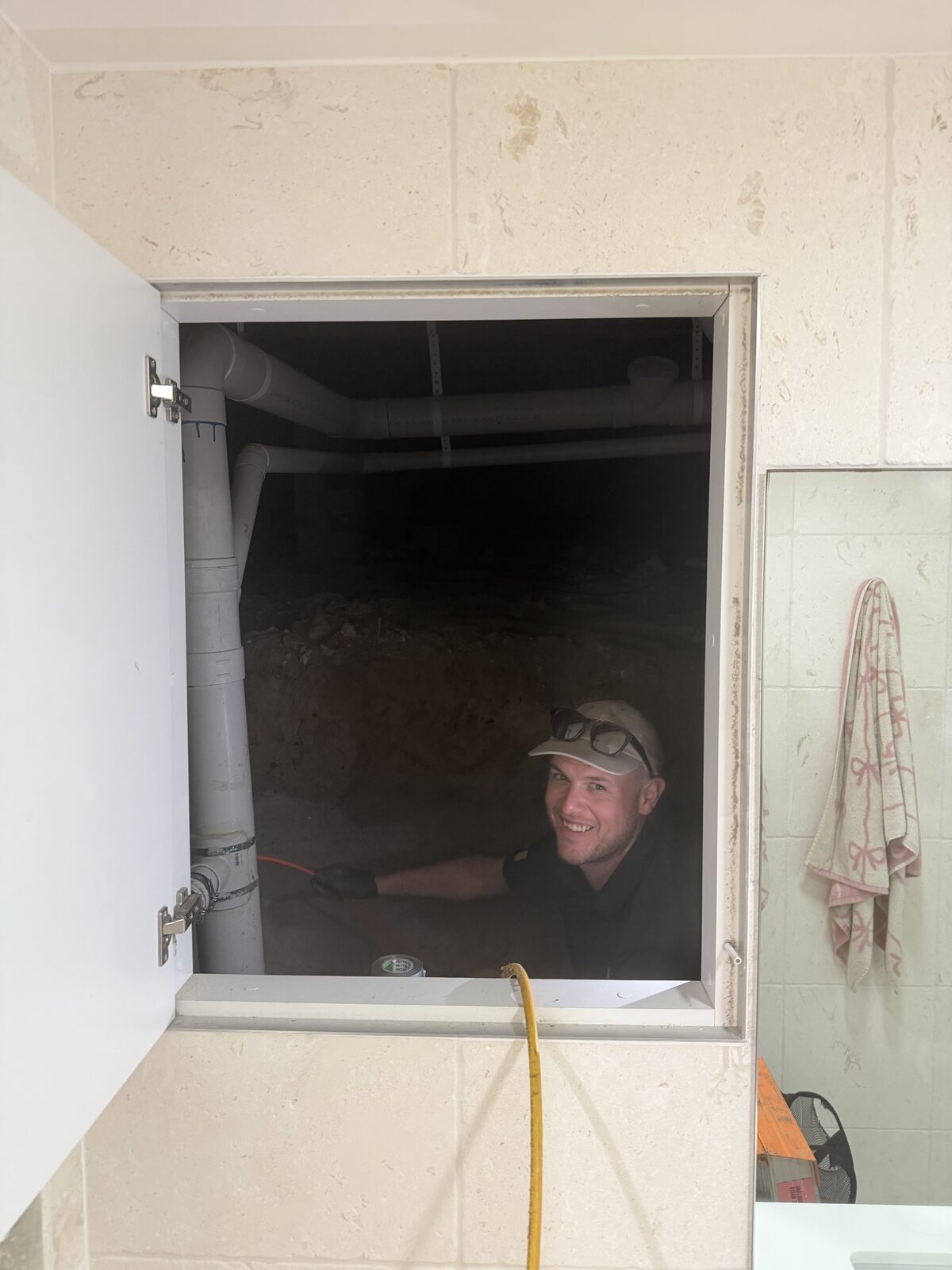
Dover Heights sits on the sandstone ridge above the cliffs, and the blocks run steeply. To get a flat floor plate, a lot of houses up there are cut into the rock, which leaves a void along one side of the building between the brickwork and the exposed rock face.
That void is where the services end up. On this house it held the rainwater tank, the pump, the stormwater lines, and the flexible ducting for the air conditioning, all sharing a gap not much wider than a person.
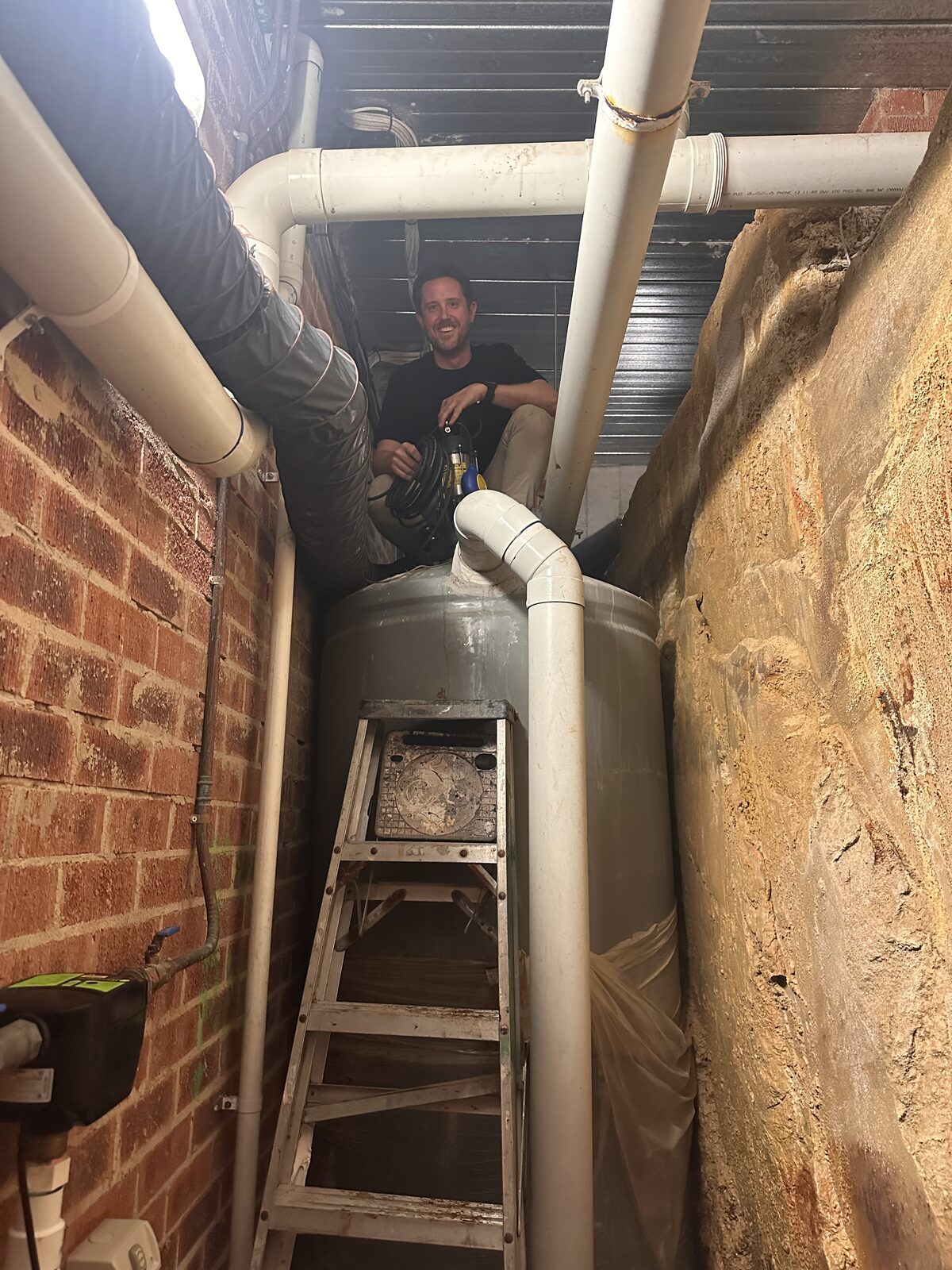
There is no natural light down there, so it is work lights the whole way. The floor above is steel decking, so there is no standing up straight either. Two of us went in, Greg and myself, because passing parts and tools back along the void is faster than one person climbing in and out for every fitting.
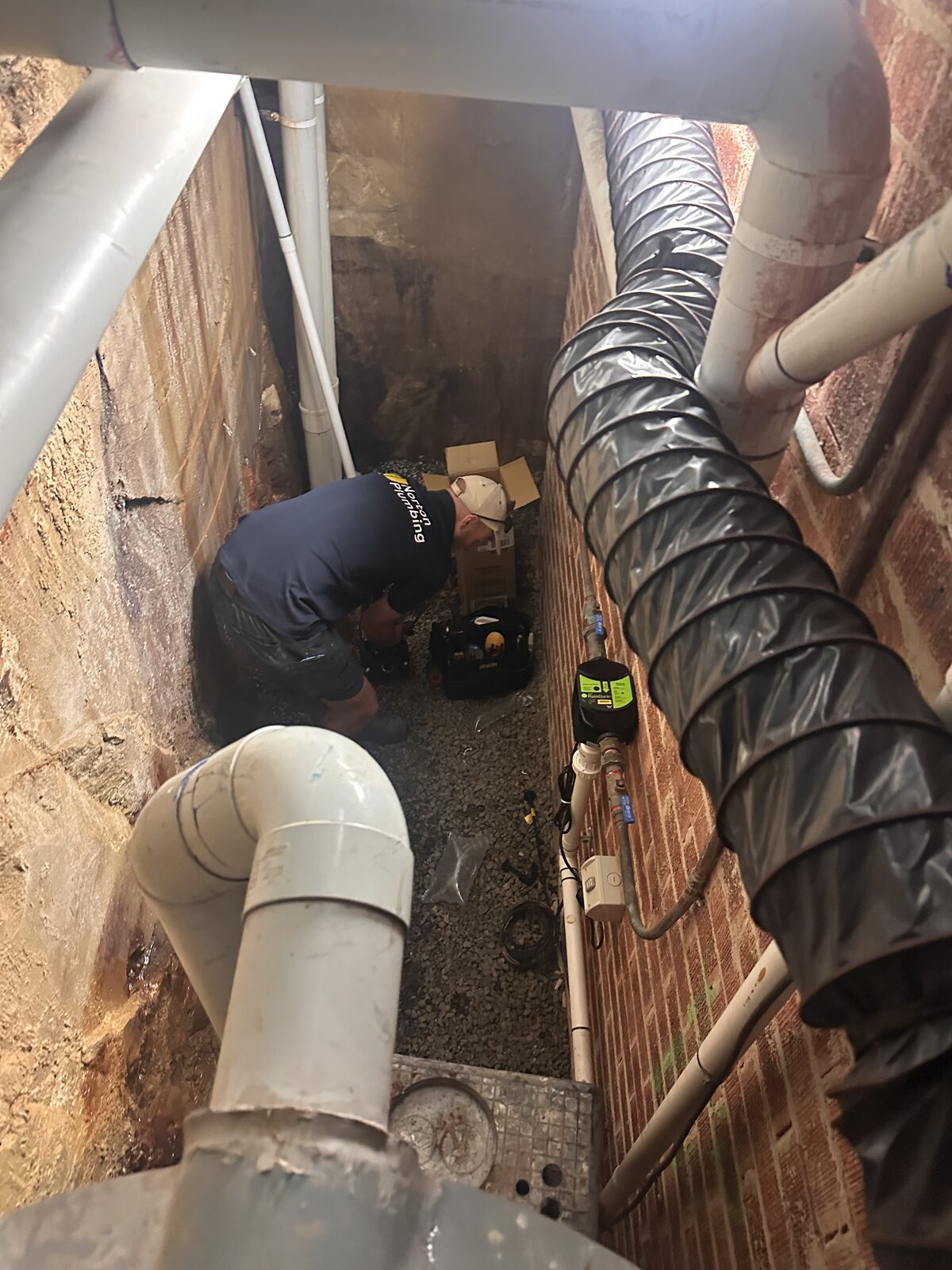
Getting the old pump out
The old pump came out first, then it sat on the gravel next to the replacement so we could check the new one matched on outlet size and on the electrical side before anything got connected.
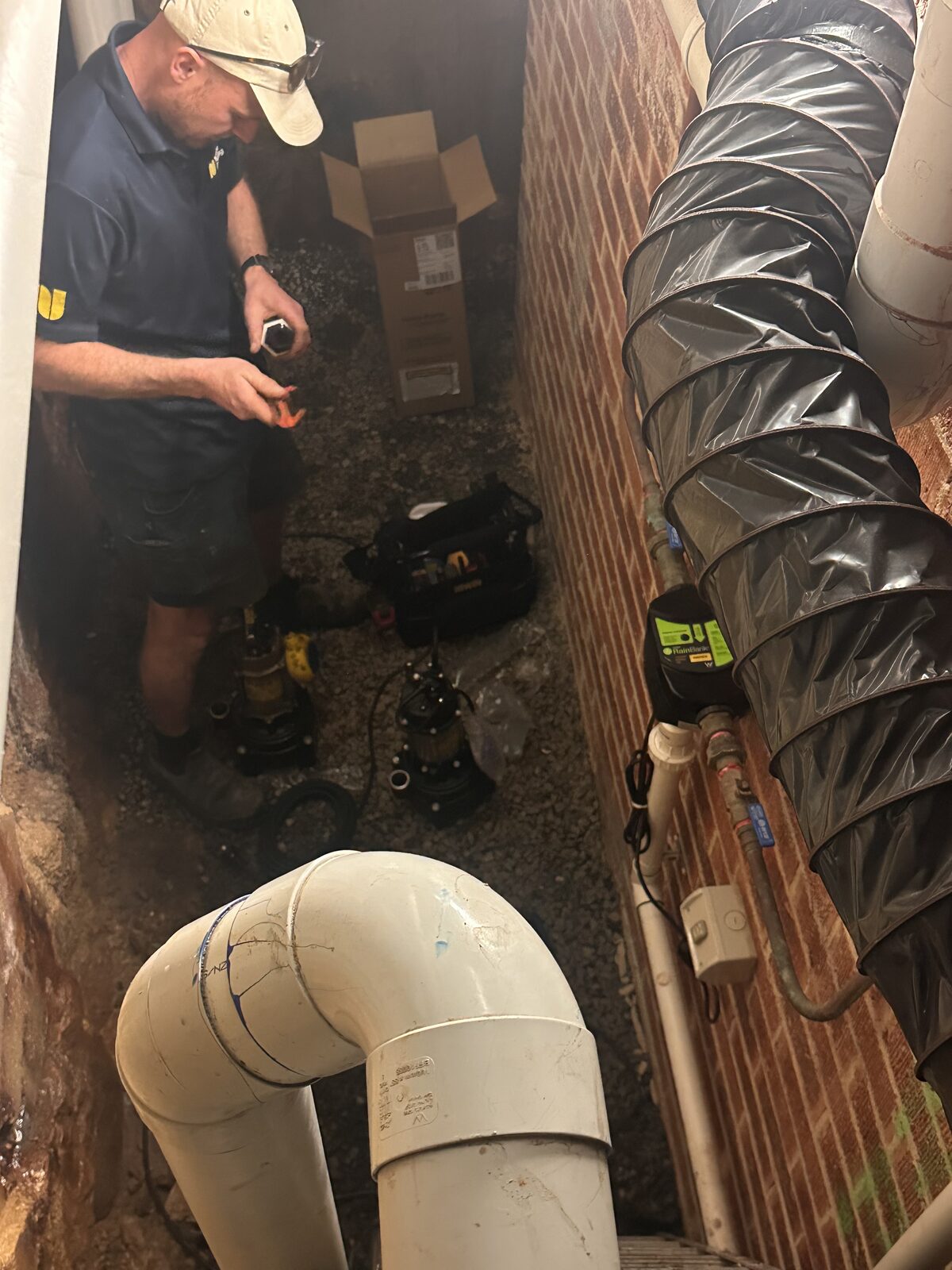
Submersible pumps in this position do not usually die of old age. They die because grit and sediment work into the seals, or because the float switch that tells the pump when to run stops moving freely. Sediment is the common one. Anything washed off a roof ends up in the bottom of the tank, and the pump sits down in it.
The replacement pump and its float switch
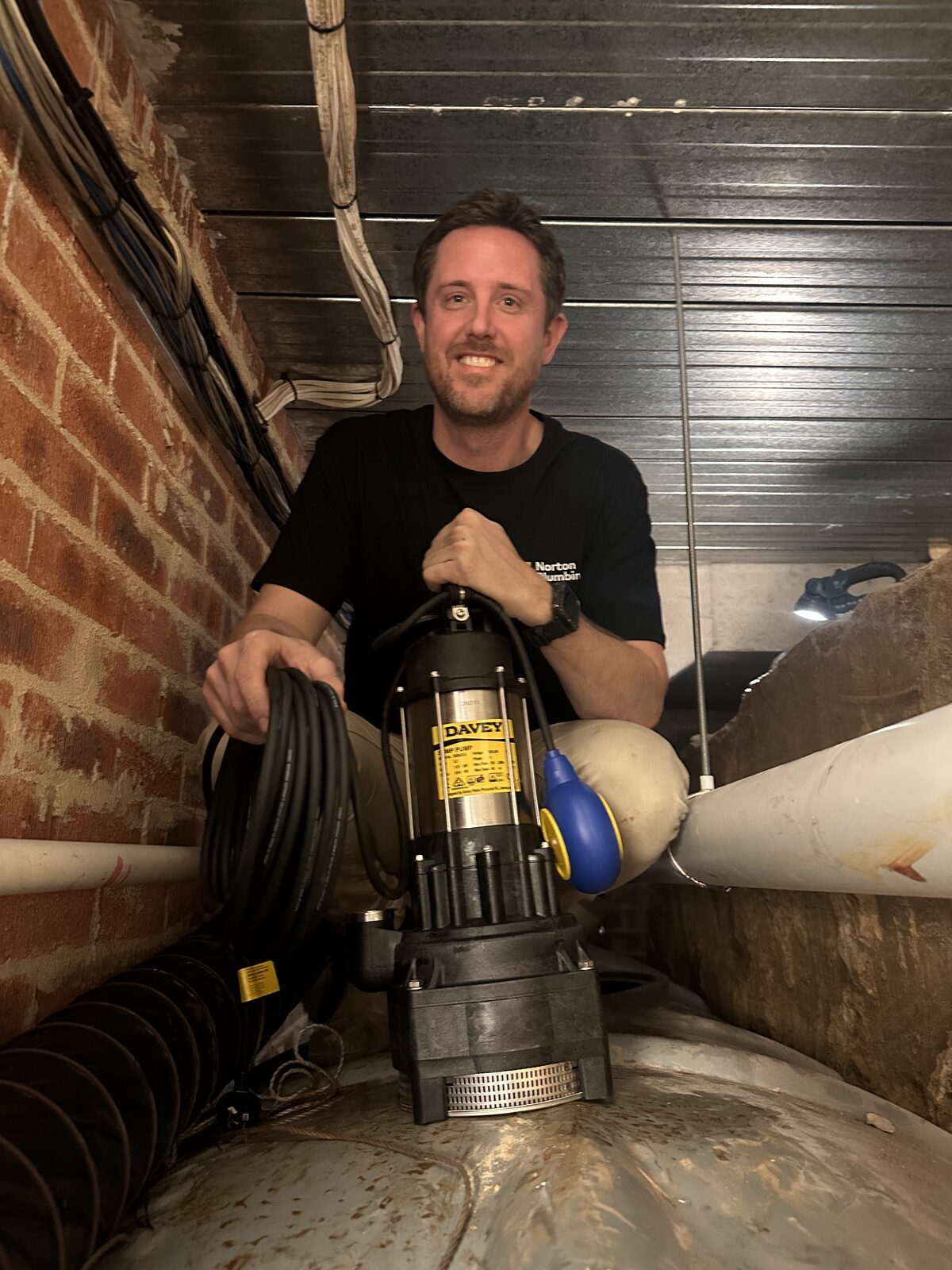
The replacement was a Davey submersible, single phase 240 volt, with a tethered float switch. The float is the black cable and the blue bulb hanging off the side of it. That bulb is what decides when the pump runs and when it stops.
Setting the tether length is the part people skip. Leave too little cable and the pump switches on and off constantly on a small change in level, which is hard on the motor. Leave too much and it runs itself dry at the bottom of the range. It gets set to the tank, not to whatever it was on the bench.
Making up the pipework before it goes in the hole
Everything that could be assembled at the top got assembled at the top. Greg made up the discharge riser and taped the threads out in the open, where you can see what you are doing and get a proper turn on a fitting.
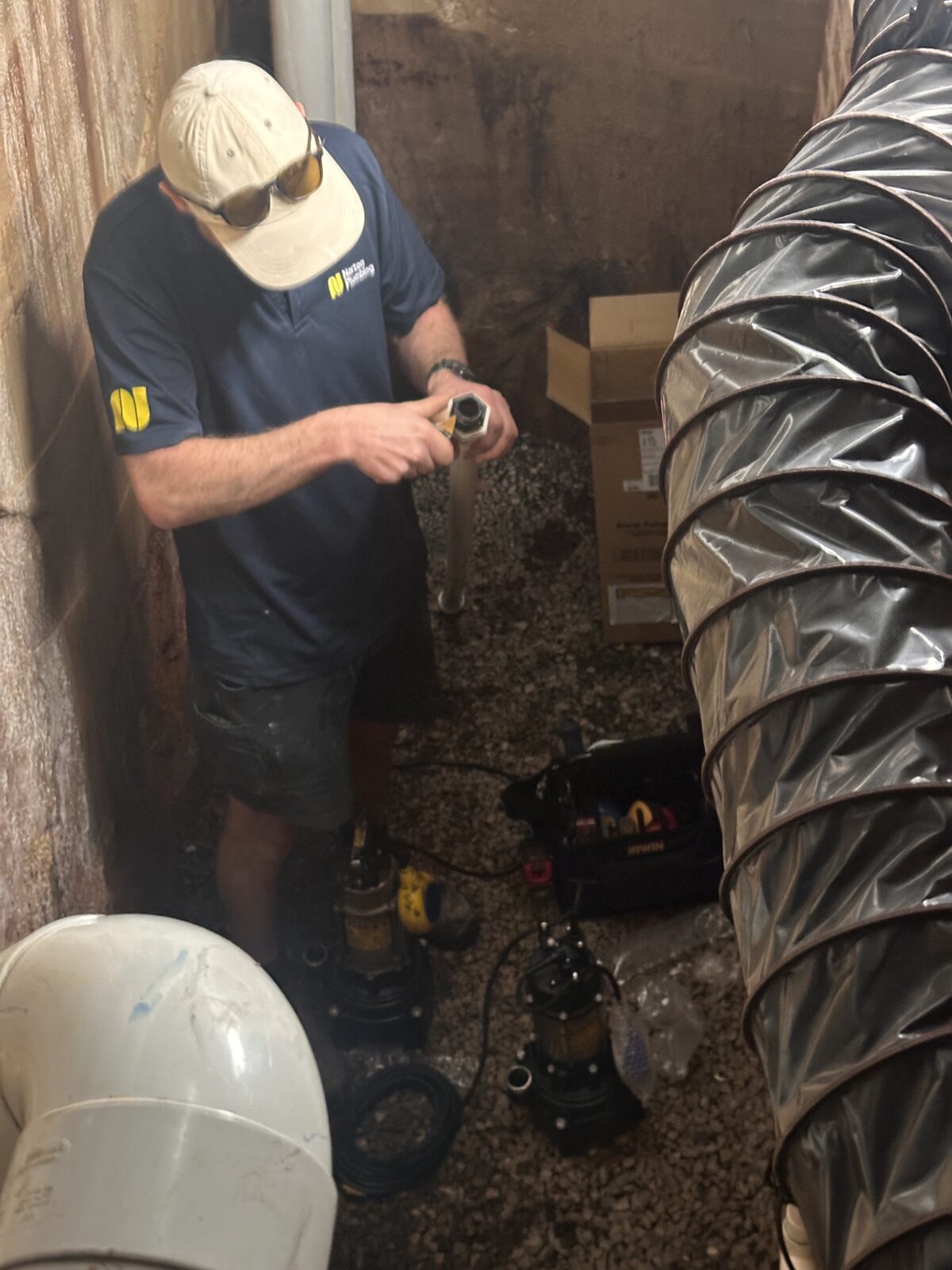
Then the pump goes onto the discharge and the whole assembly goes down as one piece. The alternative is holding a pump in one hand and a wrench in the other while lying on gravel, which is how threads get cross-fed and how a job comes back.
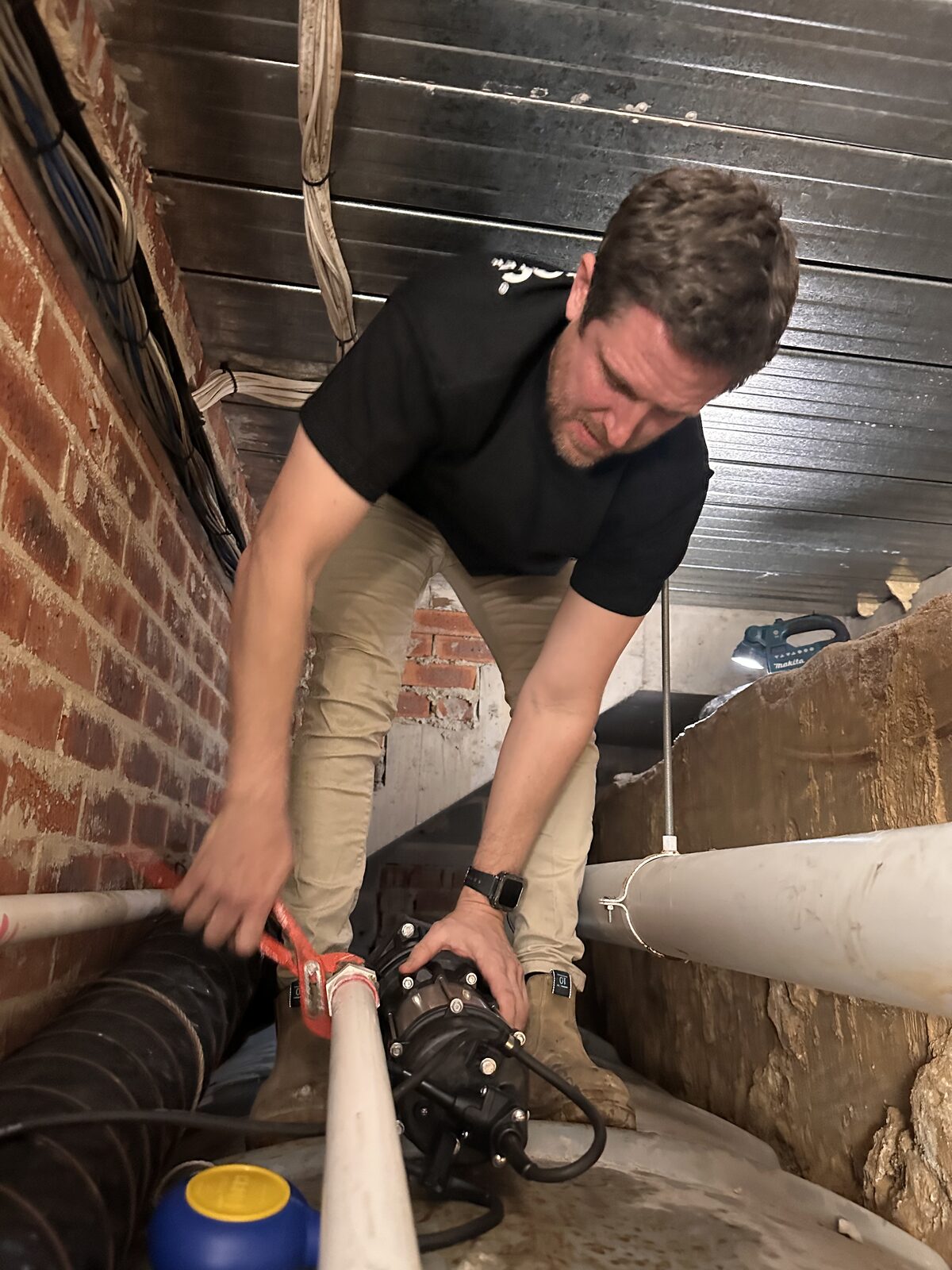
Once it was in and the power was on, it got run through a full cycle. The float has to lift the pump on and drop it off cleanly at both ends, the discharge has to hold with no weep at the joints, and the water has to actually get to where it is supposed to go. Norton Plumbing does not leave a pump job on the strength of hearing the motor start.
What the rainwater is actually for
Worth being clear about what a tank like this does in a house that also has mains water. NSW Health's rainwater tank guidance supports rainwater in urban areas for non-drinking uses, including toilet flushing, washing clothes, garden watering, car washing and filling pools. It does not recommend tank water for drinking where a utility already supplies it, because the microbiological quality of water collected in a domestic tank is generally poorer than a public supply.
So when the pump fails, what stops is the useful part. The tank keeps collecting and the household quietly goes back to paying for mains water to flush toilets and water the garden. That is the reason a dead rainwater pump is worth dealing with rather than living with.
Signs a rainwater pump is on the way out
- It runs but nothing much comes out. A worn impeller will still make noise. Pressure at the outlet is the test, not sound.
- It cycles on and off rapidly. Usually a float switch problem or a tether set too short, and it is hard on the motor either way.
- It keeps running with the tank low. The float is not dropping off. Running dry is the fastest way to finish a pump.
- It trips the circuit or the safety switch. Stop using it and get it looked at. Water and a failing motor winding are not a combination to test.
- Your water bill climbs with no change in how you use water. If the tank has quietly stopped supplying the toilets and the garden, mains water picks up the difference.
Why these jobs are common on the Eastern Suburbs ridge
Dover Heights, Vaucluse and the streets above Rose Bay share the same building pattern. Steep blocks, sandstone close to the surface, and houses that have been cut in rather than built up. Tanks and pumps get put in the leftover space along the side or under the floor, because that is the space there is.
It works fine, and it is generally where the tank belongs. It just means that the day a pump needs replacing, the pump is the cheap part and the access is the real question. Anyone quoting one of these without looking at the space first is guessing.
How to reach Norton Plumbing
Norton Plumbing has worked across Dover Heights and the rest of Sydney's Eastern Suburbs since 2019. I hold NSW plumbing licence 397768C, and we work out of 10/11a-15 Berwick St, Coogee. If you have a rainwater pump that has stopped, or water where it should not be under your house, see our blocked drains and drainage service, our emergency plumber page, or our leak detection service, or call 0477 858 951.
Frequently asked
Common questions
- How long should a rainwater pump last?
- There is no single figure worth quoting, because how a pump is run matters more than how old it is. Sediment in the tank, a float set to cycle too often, and any period spent running dry all shorten it well ahead of schedule. A clean tank and a properly set float do the opposite.
- Can I replace a rainwater pump myself?
- Swapping the unit is mechanical, but the connections from the tank to any outlet in the house are licensed plumbing work in NSW and have to be done by a licensed plumber. Whether the property also needs a backflow device depends on a site assessment, so it is not a fixed answer.
- Why does my rainwater pump keep switching on and off?
- Short cycling is nearly always the float switch. Either the tether is set too short, so a small change in water level flips it repeatedly, or the float is fouled against the tank wall or pipework and cannot swing freely. Both are hard on the motor and worth fixing early.
- If the pump fails, do I lose water to my toilets?
- Usually not. Systems plumbed into toilets and laundry are generally set up to fall back to mains supply when the tank is not delivering, so the outlets keep working. That is also why a failed pump can go unnoticed for months, showing up as a higher water bill rather than a dry tap.
- Is the pump normally inside the tank or beside it?
- Both are common. Submersible pumps sit down in the tank or in a pit below it, which makes them quiet but harder to reach. External pressure pumps sit alongside and are easier to service. On a tight site the pump tends to end up wherever there was actually room for it.
- Should the tank be cleaned when the pump is replaced?
- It is the right moment to look at it. Everything washed off the roof settles in the bottom of the tank, and that sediment is what wears out the next pump. If there is a meaningful layer of sludge down there, clearing it while access is already open saves opening it up again later.
Related service
Blocked Drains
Fast, professional blocked drain clearing in Eastern Suburbs Sydney
See our blocked drains pageNeed a plumber in the Eastern Suburbs?
Call 0477 858 951