Drainage · 8 min read
Tree roots in old clay drains: the Eastern Suburbs problem that never goes away
Half the homes in our service area still have clay sewer pipes from the 1950s and 60s. Why they keep blocking, and what a long-term fix looks like.
Adam Norton · 10 April 2026
If your house was built before 1980, there's a high chance the sewer line from your home to the boundary is still terracotta clay pipe. Half the homes in Sydney's Eastern Suburbs still are. And in a tree-lined inner-Sydney suburb, those clay pipes are doing daily battle with mature root systems that have been searching for water since the trees were planted.
Tree roots in a drain in Sydney's Eastern Suburbs is the single most common reason for the same drain blocking year after year. Once a root finds a way into a clay sewer, the cycle is hard to stop with clearing alone. The roots regrow, the joint stays leaky, and the homeowner ends up booking a plumber every twelve to eighteen months for the rest of their life unless the underlying problem is fixed.
This article is what causes roots to grow into sewer drains, why the Eastern Suburbs has the problem more than most parts of Sydney, how to know for certain that roots are the cause, and what a permanent fix looks like.
Why roots find their way into drains
Tree roots aren't aggressive in the colloquial sense. They don't seek out pipes to attack them. What they seek out is moisture and nutrients, and a slightly-leaking sewer line is the most reliable concentrated source of both that exists below ground level.
The mechanics are simple. A sewer line carries a continuous slow flow of warm, nutrient-rich wastewater. If a joint between two sections of terracotta pipe has a hairline crack or a small displacement, water vapour escapes into the surrounding soil. Roots growing in that soil sense the moisture gradient and grow toward the source. When a root reaches the joint, it pushes through the existing crack and starts drawing water and nutrients directly from inside the pipe.
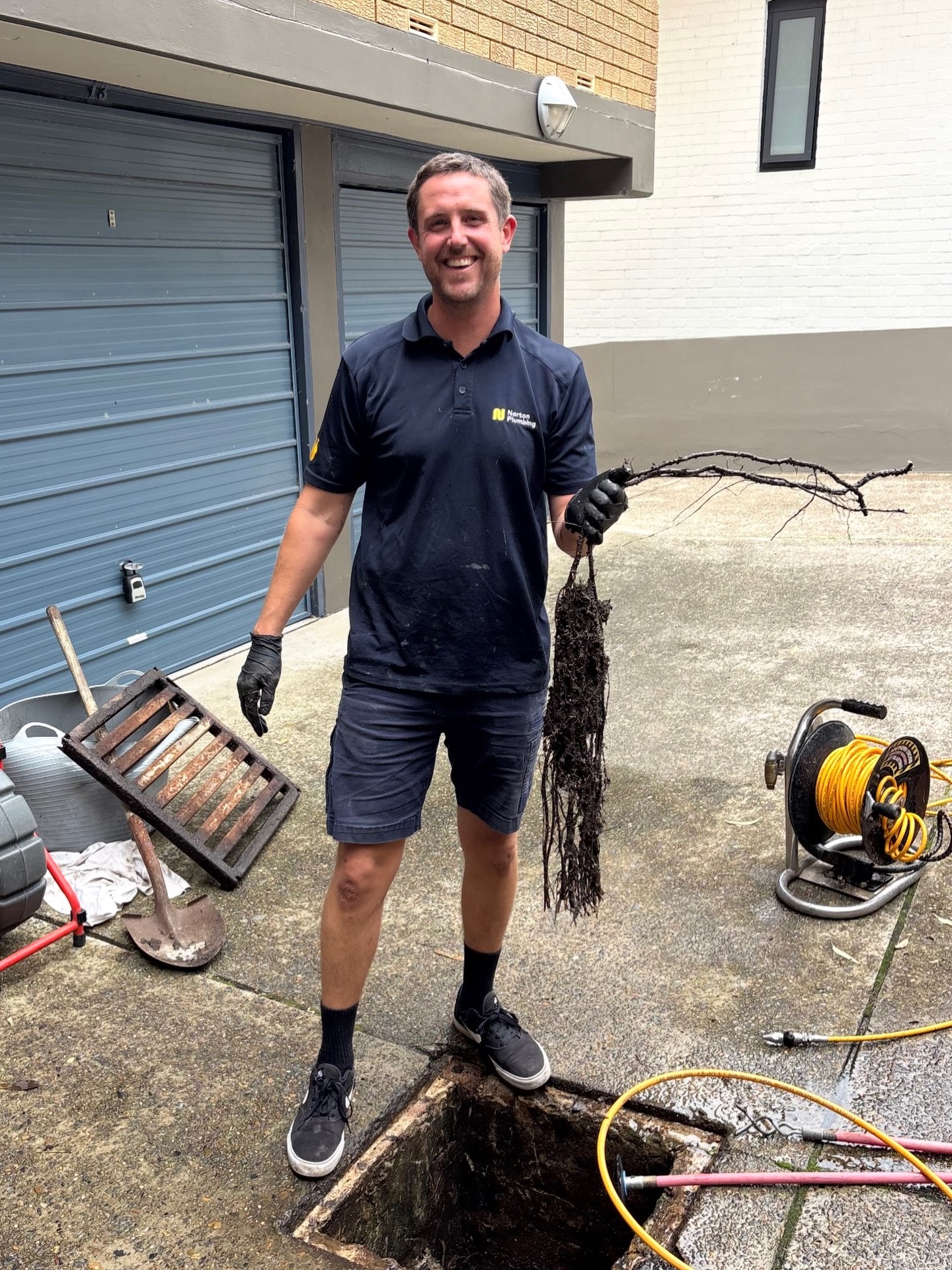
Once a root is inside, it grows fibrous secondary roots that fill the pipe interior over time. These secondary roots are what catch wet wipes, toilet paper, food grease, and other normal household material that would otherwise pass through. The blockage isn't the root by itself. It's everything that catches on the root.
Why the Eastern Suburbs sees it more than most
Three factors combine to make tree roots in drain sydney a particular Eastern Suburbs problem:
- Pre-1980 housing stock. A meaningful share of homes in Coogee, Bondi, Randwick, Bronte, and Clovelly still have their original terracotta drainage. Terracotta is durable but its joints aren't designed to seal under pressure, so any settlement, root pressure, or ground movement opens an entry point over decades.
- Mature street and garden trees. The Eastern Suburbs has decades of established planting. Fig trees, gums, and jacarandas on the street and in front gardens have root systems that easily reach a property's sewer line, particularly on smaller heritage-era lots.
- Sandy and reactive soils. Many parts of the Eastern Suburbs have free-draining sandy soils that move with rainfall and dry periods. The ground around a terracotta pipe shifts more than it would in stable clay soil, which opens up joints faster and gives roots more openings to exploit.
If your home is in a tree-lined Eastern Suburbs street, predates the 1980s, and the drain blocks more than once every couple of years, roots are the working assumption until proven otherwise.
How we know it's roots and not something else
Roots in a drain produce a specific pattern that's distinctive on inspection:
- The blockage recurs in the same spot. CCTV inspection shows the entry point is a single joint or crack, not multiple locations.
- The material removed during clearing is fibrous. A jetting visit brings back what looks like a tangled brown mat, sometimes with toilet paper and other debris caught in it.
- The recurrence interval is fairly predictable. Most root-related blockages cycle every twelve to twenty-four months from clearing to next blockage, depending on the tree species and the size of the entry point.
- The blockage often happens after rain. Wet weather encourages root growth around the joint and pushes new fibrous growth into the pipe interior.
If a CCTV camera shows fibrous growth at a specific joint, the diagnosis is straightforward. Norton Plumbing always records the camera footage on root jobs and provides a copy to the homeowner so the diagnosis is verifiable.
What works long-term, and what doesn't
Short-term root clearing is fine as a stopgap, but it's not a fix. Here are the realistic options, in order of cost and durability:
- High-pressure jetting with a root-cutting head. Cuts and flushes the existing fibrous mat. Restores flow. Doesn't change anything at the joint, so the roots regrow. Cycle: roughly 12 to 24 months. Cheapest option.
- Jetting plus a foaming root inhibitor (a slow-release herbicide product approved for sewer use). Suppresses regrowth for somewhat longer than jetting alone. Still not a permanent fix. Cycle: roughly 18 to 36 months.
- Spot pipe relining at the entry point. A short cured-in-place liner inserted into the affected joint creates a watertight seal that roots cannot push through. No excavation. Effective when the root entry is localised to one short section.
- Full-length pipe relining of the affected drain. The entire run of terracotta is lined with a cured resin tube that becomes the new internal pipe. Watertight, root-proof, and structurally a new pipe with a design life of 50 years or more, typically backed by a 10 to 25 year warranty. Recognised by Sydney Water as an accepted permanent repair method for sewer lines on private property. The standard long-term fix for older Eastern Suburbs homes with multiple root entries.
- Excavation and pipe replacement. Reserved for sections that are too collapsed or distorted for relining, or where the fall (downhill grade) needs to be corrected. More disruptive and usually more expensive than relining, but sometimes the only option.
Which path makes sense depends on the camera footage, the number of root entries, and the property's access conditions. Norton Plumbing quotes each path in writing on-site so the trade-offs are visible and the homeowner makes the call, not the plumber.
Prevention going forward
If your drain is already a known root problem and you've chosen jetting over relining for now, there are a couple of things that reduce the cycle length:
- Don't plant new trees within a few metres of the known drain line. The line's path is on the property's plumbing diagram (council records) or can be located with a sonde during the next jetting visit.
- Avoid flushing material that catches easily on roots. Wet wipes are the biggest single offender, including ones labelled flushable.
- Have the drain CCTV-inspected every couple of years rather than waiting for the next blockage. Catching new root entries before they become full blockages is cheaper than emergency callouts.
- When the drain blocks, choose the slightly longer jetting visit that includes a camera run, not a quick clear-and-go. The footage tells you whether the root entry has stayed the same or grown.
How to reach Norton Plumbing
Norton Plumbing has been clearing and relining root-affected drains across Sydney's Eastern Suburbs since 2019. We operate from 10/11a-15 Berwick Street, Coogee NSW 2034. Phone: 0477 858 951. I'm Adam Norton, NSW plumbing licence 397768C, and I attend most jetting and relining jobs personally with Blake. We work across Eastern Suburbs including Bondi, Coogee, Randwick, Maroubra, and Kingsford. During business hours there is no callout fee. For more detail on the long-term fix, our pipe relining service page covers the process, and the blocked drains service page covers what a clearing call involves.
Frequently asked
Common questions
- How can I tell if tree roots are causing my blocked drain?
- The most reliable signal is recurrence. If the same drain blocks every twelve to twenty-four months, particularly after rain, roots at a single joint are the most likely cause. A CCTV camera inspection confirms it quickly. The material removed during clearing also tells the story: tree roots produce a distinctive fibrous brown mat.
- Will a jetter completely remove tree roots from my drain?
- Jetting removes the visible fibrous growth and restores flow, but it doesn't seal the entry point at the cracked joint. The original root keeps growing back through the same opening. Most cleared root-affected drains block again within twelve to twenty-four months, depending on the tree species and how large the entry point is.
- Is pipe relining a permanent solution to root intrusion?
- Yes, when done correctly. A cured-in-place liner forms a continuous watertight pipe inside the old one, leaving no joint or crack for a root to push through. Most modern liners have a design life of 50 years or more, typically backed by a 10 to 25 year warranty. Relining is the standard long-term fix for terracotta drains with repeat root problems.
- Can I plant trees near a sewer drain in the Eastern Suburbs?
- Yes, but not directly above the line and not within a few metres of it for vigorous root-growing species like figs, gums, willows, and rubber trees. Smaller ornamental species placed away from the drain path are generally safe. The drain location is on the property's plumbing diagram or can be located by a plumber.
Related service
Pipe Relining
No-dig pipe relining in Eastern Suburbs Sydney - fix broken pipes without destroying your property
See our pipe relining pageNeed a plumber in the Eastern Suburbs?
Call 0477 858 951