Case study · 6 min read
Whole-house water filter, Randwick
A Puretec FilterWall F5 went in on the mains at a Randwick home, so every tap in the house is filtered, not just the one at the kitchen sink.
Adam Norton · 18 August 2026
The owners of this Randwick house had just come to the end of a renovation. Kitchen done, bathrooms done, landscaping finished. Filtered water was the item that had been sitting on the list since the plans went in, and it was the last thing left.
What they did not want was a jug in the fridge or a second little tap beside the new kitchen mixer. They wanted the water sorted for the whole house. So the job was a whole-house water filter on the incoming mains rather than anything at the sink.
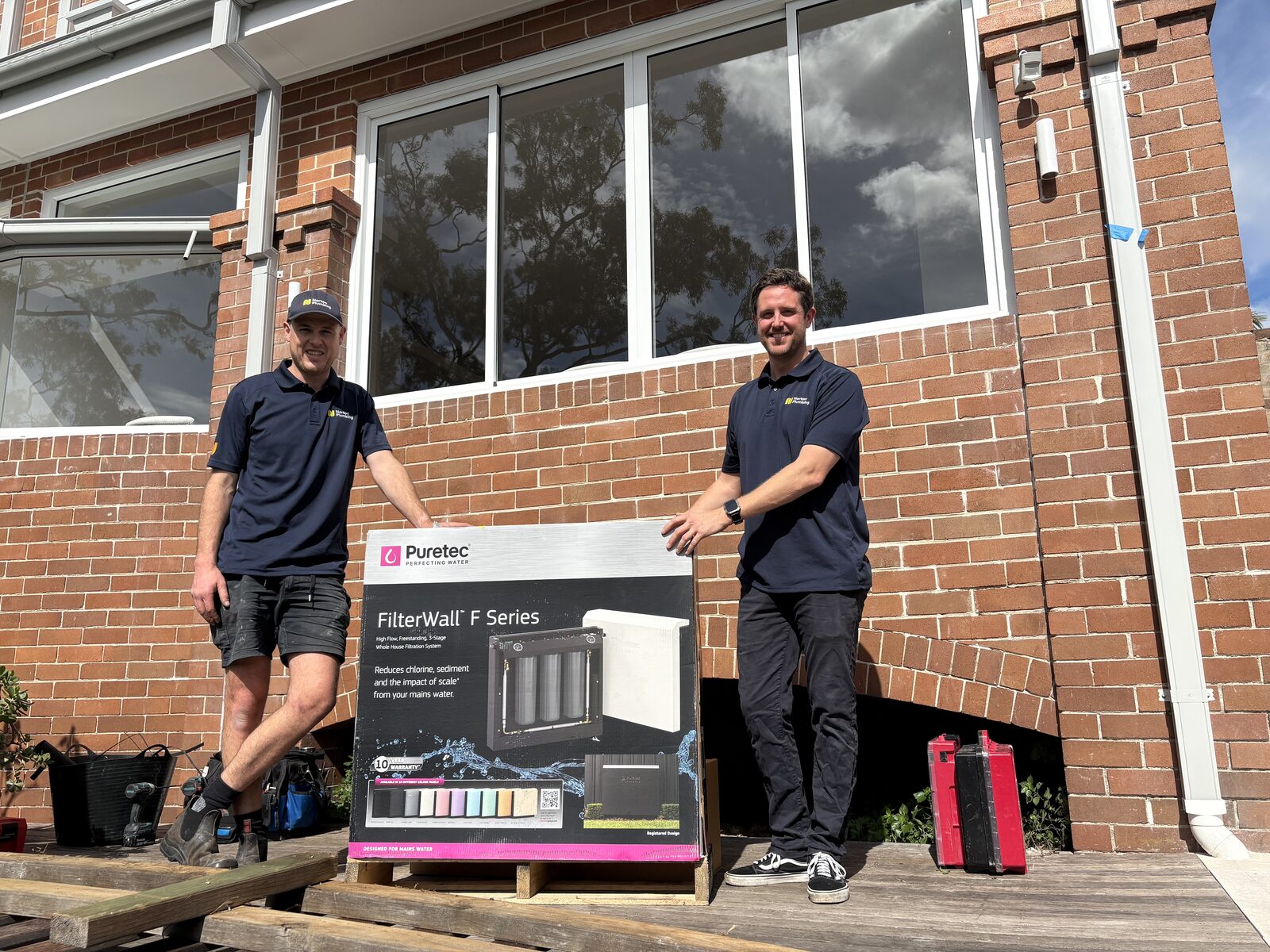
What went in at the Randwick house
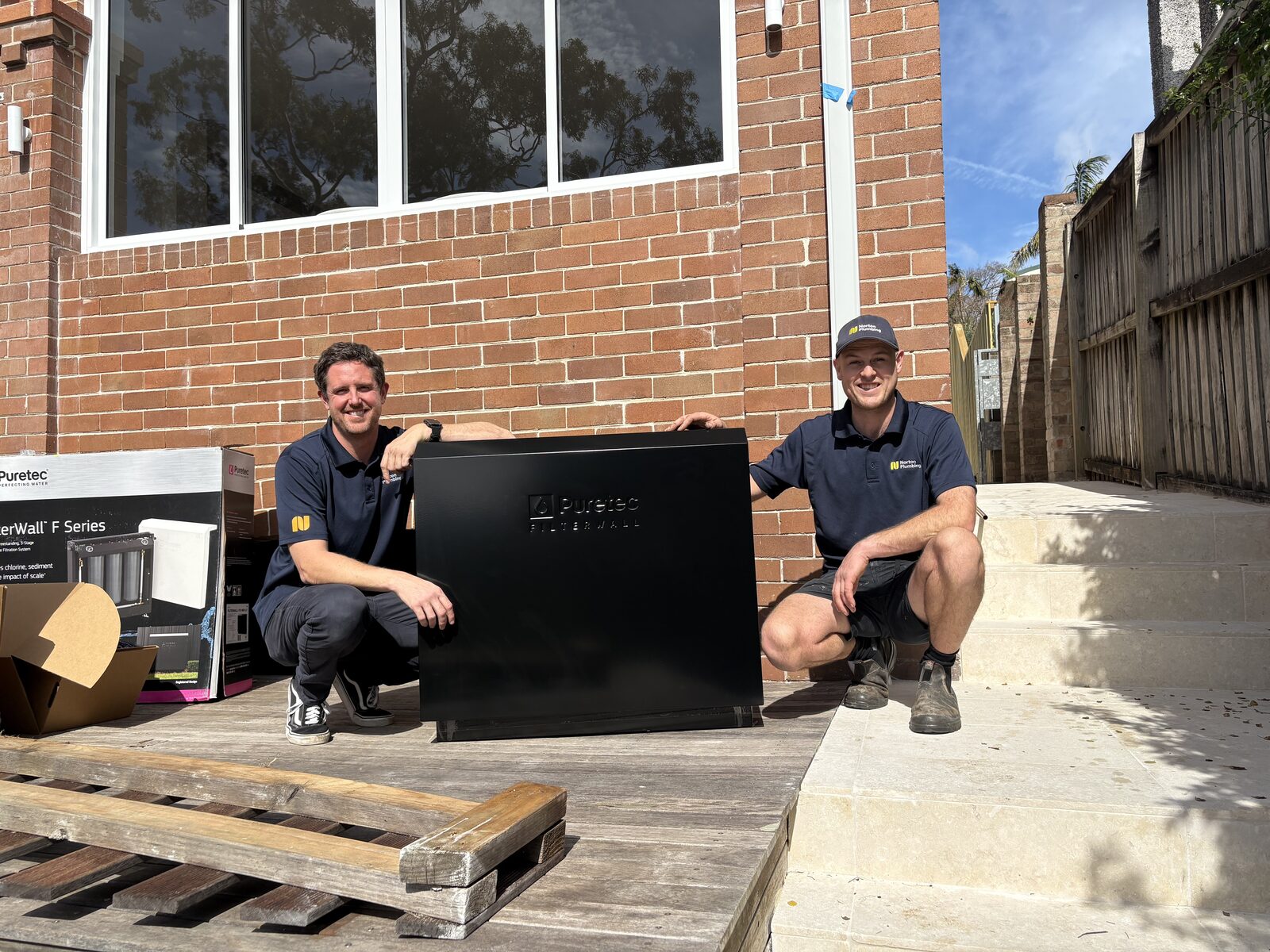
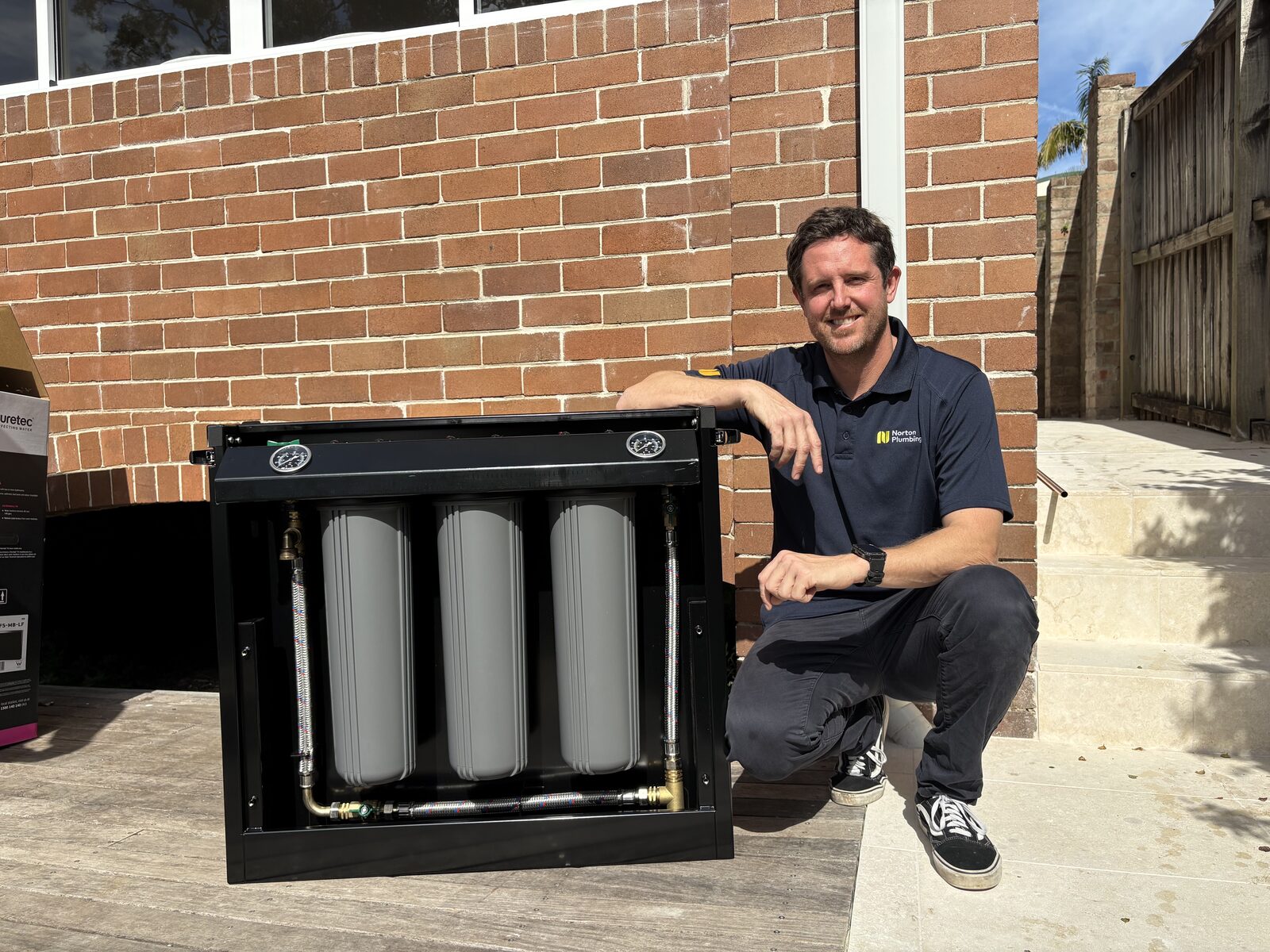
The system is a Puretec FilterWall F5. It is a three stage, free-standing whole-house water filter designed to sit outside along a fence line or against the side of the house, which is exactly where this one went.
It is a cabinet rather than a set of exposed canisters. That matters more than it sounds. A filter housing bolted to a wall in the open weathers, discolours and ends up looking like plant equipment on the side of a house that somebody has just spent a renovation making look good. The FilterWall is a lockable powder-coated enclosure with the filtration inside it, and Puretec make it in a range of colours so it can be matched to the house rather than fought with.
Why a whole-house water filter goes on the mains
A whole-house water filter is plumbed into the incoming water main, at the point where the supply arrives at the property and before it splits off to anything inside. Everything downstream of that point is filtered.
That is the whole argument for it over an under-sink filter, and it is worth being precise about the difference rather than treating them as two sizes of the same thing. An under-sink filter treats one tap. It is the right answer in plenty of homes, particularly apartments, where the incoming main is common property and putting a filter on it is not something one owner can arrange. But it only ever covers the water you draw at that sink.
On the mains, it is every outlet. The kitchen, both bathrooms, the shower, the laundry, the outside tap. That is what these owners were paying for, and it is the reason a freestanding house is where this system makes the most sense.
- The main belongs to the property owner. In a house the incoming main is yours to work on. In a strata block it is common property, which rules out a whole-house unit for a single lot.
- There is somewhere to put it. A freestanding unit needs a run of ground along a fence line or side passage, with clearance to open the door and draw cartridges out. Houses in Randwick generally have that. Apartments do not.
- It treats the water once. One system at the front of the property instead of a filter under every sink that needs one.
What the FilterWall F Series reduces
Worth being exact here, because filtration gets oversold. On Puretec's own specification the F Series reduces chlorine by up to 98%, along with sediment and the impact of scale in the mains water coming into the property. Puretec also list the FilterWall F5 among their solutions for reducing PFAS, the group of compounds usually called forever chemicals.
The chlorine is the part people notice first, and it is the part that is most misunderstood. Sydney Water adds chlorine at the reservoir and it does a real job keeping the supply safe across thousands of kilometres of pipe on the way to you. It is not a contaminant and it is not a failure of the network. It has simply finished its work by the time the water reaches your property, and from that point it is only a smell and a taste. Most households notice it in the shower before they notice it in a glass.
Puretec put the rest of the benefits as softer hair, less irritated skin, softer laundry, protected appliances, healthier plants and less plastic waste from bottled water.
Why Sydney's soft water changes which model suits
The F Series comes in four models, and the choice between them is not just about the size of the house. It is about water hardness, and this is where a lot of generic filtration advice written for other cities gets Sydney wrong.
Puretec split the range at 80 parts per million of hardness. The F3 and F5 are specified for water under that figure. The F4 and F6 are for water between 80 and 140 ppm, and they carry a dedicated scale reduction cartridge in the third stage to deal with it. The F3 and F4 are sized for small to medium houses, the F5 and F6 for larger houses with two or more bathrooms.
This Randwick house took the F5. It has more than one bathroom, so it needed the larger of the two soft water models, and the scale reduction cartridge in the F6 would have been solving a problem Sydney does not really have.
Sydney is soft water. Roughly 80% of the supply starts as rainwater in Lake Burragorang behind Warragamba Dam, in a catchment that is largely Hawkesbury sandstone, and sandstone gives up very little calcium or magnesium. The result across Sydney Water's supply zones runs from about 30 to 58 mg/L as calcium carbonate, averaging in the low 40s, which sits inside the 0 to 60 band classed as soft. You can look up the tested figures for your own postcode on Sydney Water's water analysis page.
So in an Eastern Suburbs house the scale reduction stage is rarely the thing making the decision. Chlorine and sediment are. Anyone quoting you a whole-house system on the basis that Sydney has a hard water problem is selling from a script written somewhere else, and the honest version is that the deciding factors here are the size of the house, the flow rate the household needs, and where the unit can physically go.
Why filtration comes up at the end of a renovation
This job is the pattern rather than the exception. Most of the whole-house filtration Norton Plumbing installs goes in either during a renovation or, like this one, immediately after it.
Part of that is practical. During a reno the trades are already on site, the ground is already open in places, and the incoming main is a great deal easier to get at than it is once the landscaping has gone back. Part of it is simply that a renovation is when people look properly at the house for the first time in years, and water is one of the last things to get thought about because it arrives invisibly and nobody questions it.
Randwick is full of the housing stock where this works: freestanding and semi-detached brick houses with a side passage or a fence line, on their own water service. That is the practical requirement for a freestanding system, and it is why the whole-house conversation is a house conversation in this part of Sydney while the apartment conversation is almost always an under-sink one.
The other honest point about timing is that it is far easier to do this while a renovation is being planned than to add it afterwards. Not impossible afterwards, as this job shows. Just easier before the paving goes down.
Cartridges, warranty and living with it
A filtration system like this is not a fit-and-forget item, and anyone who tells you otherwise is setting you up for a disappointment. The cartridges are consumable. They load up with what they have taken out of the water, and once they are loaded they stop doing much.
Puretec's specification for the FilterWall is a cartridge change every 6 to 12 months depending on water quality and household use, and an annual change is the usual cadence for Eastern Suburbs homes. The fine sediment cartridge in some models is washable, so it can be rinsed and put back rather than replaced. A drop in pressure at the taps is usually the first sign a change is due, and it is worth acting on rather than waiting, because a blocked cartridge restricts the whole house rather than one outlet.
The system carries Puretec's 10 year warranty, which is one year parts and labour and nine years parts only, and excludes cartridges as every filter warranty does. The F Series is WaterMark certified to AS 3497, which is the standard that matters for anything plumbed into a drinking water supply in Australia.
One thing a whole-house filter will not do is make unsafe water safe. Sydney's mains supply is already treated to the Australian Drinking Water Guidelines and it is safe to drink from the tap. What changes is the chlorine smell, the taste and the sediment. If you want to see the same system on a different house, there is a FilterWall install in Clovelly on this blog, and our water filtration page sets the whole-house and under-sink options out side by side.
How to reach Norton Plumbing
Norton Plumbing has worked in Randwick and across the Eastern Suburbs since 2019 and is a Puretec Specialist Plumber. I hold NSW plumbing licence 397768C and do the filtration installs myself, and the team works out of 10/11a-15 Berwick St, Coogee. If you are weighing up a whole-house water filter, or you are planning a renovation and want to sort the water while the ground is open, see our water filtration service page, our Randwick plumber page, or call 0477 858 951.
Frequently asked
Common questions
- Will a whole-house water filter reduce my water pressure?
- A correctly sized system should not make a noticeable difference. The F Series is rated to 30 litres per minute on the smaller models and 55 on the larger ones, so the model is matched to the number of bathrooms. Pressure drop that you can feel usually means a cartridge is loaded and due for a change.
- Where does a whole-house water filter get installed?
- On the incoming water main, before it splits off to the house. The FilterWall F Series is free-standing and designed to sit outside along a fence line or against the side of the house, so it needs a run of ground with clearance to open the door and draw cartridges out.
- Can you install a whole-house filter in an apartment?
- Generally no. In a strata block the incoming main and the riser are common property, so filtering them is a building decision rather than something an individual owner can arrange, and most units have no external wall or passage to mount a free-standing cabinet on. An under-sink filter is the usual answer instead.
- How often do FilterWall cartridges need changing?
- Puretec's specification is every 6 to 12 months, varying with water quality and household use, with an annual change the usual cadence locally. Some models use a washable fine sediment cartridge that can be rinsed and refitted rather than replaced. Falling pressure at the taps is the usual first sign, and cartridges are excluded from the system warranty.
- Does a whole-house filter reduce PFAS?
- Puretec list the FilterWall F5 among their PFAS solutions, describing it as absorbing PFAS through sediment filtration and activated carbon. The correct word is reduces rather than removes. For the lowest achievable levels Puretec pair a whole-house unit with an under-sink reverse osmosis system at the drinking tap.
- Is Sydney's water hard enough to need scale reduction?
- Usually not. Sydney's supply averages around 43 mg/L as calcium carbonate and ranges roughly 30 to 58 across supply zones, which is classed as soft. Puretec only specify their scale reduction models above 80 ppm, so in the Eastern Suburbs the deciding factors are normally chlorine, sediment and flow rate.
Related service
Water Filtration
Whole-home Puretec FilterWall installation in Eastern Suburbs Sydney - two-stage sediment and carbon filtering for every tap in the house
See our water filtration pageThinking about filtered water at home?
Whole-house and under-sink filtration set out side by side, with what each one treats and where it goes.
See water filtration optionsNeed a plumber in the Eastern Suburbs?
Call 0477 858 951