Case study · 7 min read
Whole-house water filter, Bondi
A Puretec FilterWall F5 went in on the mains at a Bondi cottage at the end of a renovation, so every tap in the house runs filtered, not just the kitchen.
Adam Norton · 10 September 2026

The owners of this Bondi house had spent a couple of years renovating. Most of the house was finished, and water filtration was the last thing on the list. Vince had been running a manual ceramic candle filter for drinking water for years and wanted to stop thinking about it.
What he asked for was specific. Not a jug in the fridge, and not one filtered tap at the kitchen sink, but filtration across the whole house, plus drinking water straight from the tap. Those are two different jobs, which is why this install ended up being two systems rather than one.
In his own words
Hear from our customer, Vince
Vince had the Puretec FilterWall fitted at his home in Bondi. In this short clip, he talks about his family's sensitive skin, things he tried first, and why whole-home filtration was the right decision for his family.

What went in at the Bondi house
The main system is a Puretec FilterWall F5, a three stage, free-standing whole-house water filter that sits on the incoming mains. The wording on the carton is the honest version of what it does: it reduces chlorine, sediment and the impact of scale from your mains water. It is WaterMark certified to AS 3497 under licence WM 74617.
The F5 is the larger of the two models Puretec specify for soft water, rated to 55 litres per minute. That matters in a house with more than one bathroom. A whole-house filter sits in front of every outlet, so it should not become the bottleneck when two showers run at once.
Alongside it, a Puretec PureMix Z7 went in under the kitchen sink. That is a high flow inline filter running off the existing mixer tap, so there is no second spout cluttering a new benchtop. The FilterWall handles the water reaching every shower, basin, bath and laundry outlet. The Z7 gives the kitchen a final stage for drinking and cooking. We have written up a standalone version of that smaller job in the Coogee under-sink filter case study.
Fitting a whole-house water filter into a Bondi side passage
The mains at this house come in down the side, and the side passage is about as narrow as they get in Bondi. It was also already crowded. A home battery is mounted on the same wall, with its isolator and the switchboard immediately beside it.

So the first job was not plumbing, it was measuring. The FilterWall is a cabinet rather than a set of exposed canisters, and that is a large part of why people accept it on a wall they can see. But a cabinet only works if the door opens fully. Cartridges are changed with the door swung out, and in a passage that tight, the gap between a good position and an awkward one is a couple of hundred millimetres.
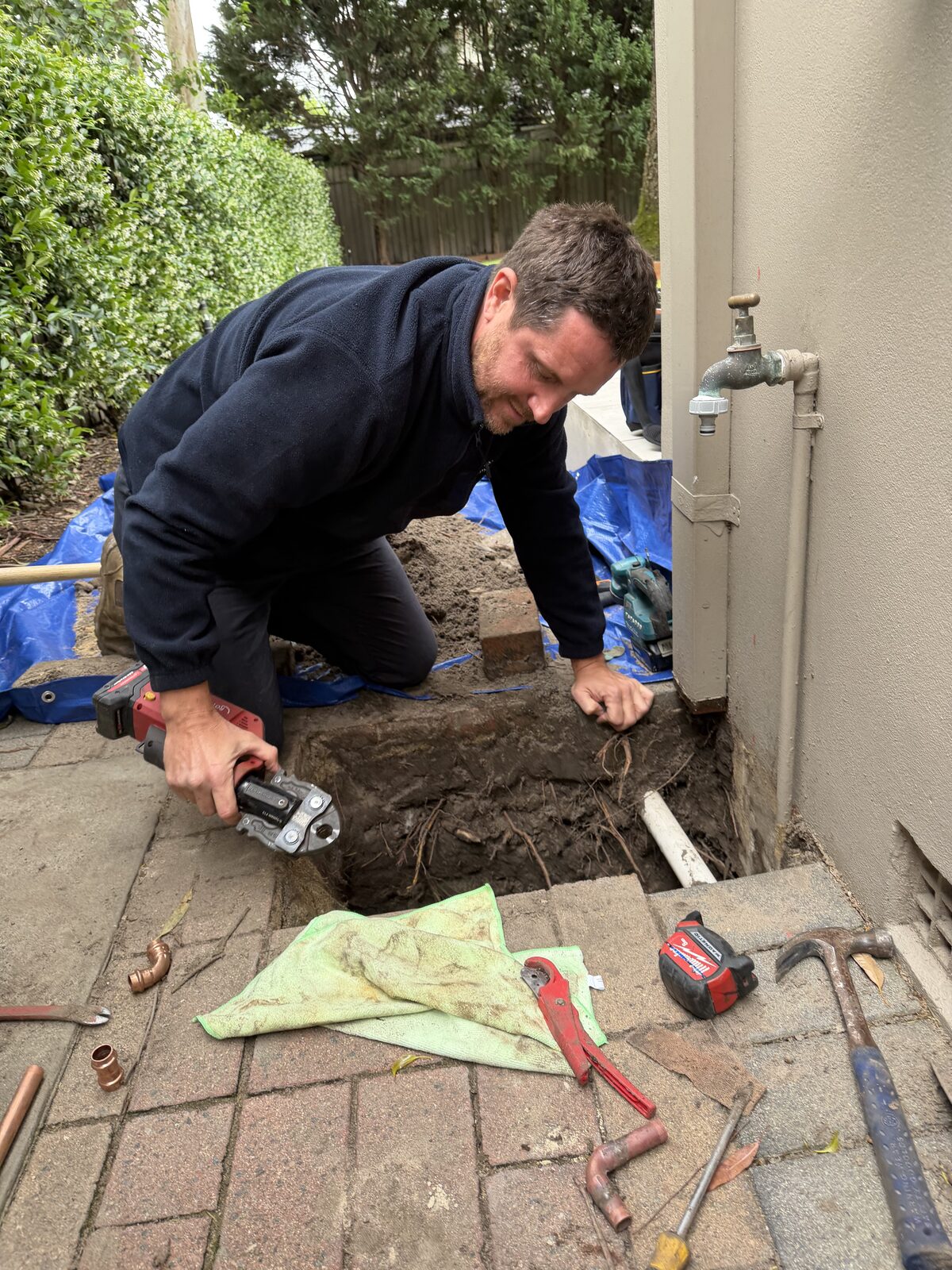
Once the position was set, the tie-in went in at the mains, with copper run up the wall into the cabinet and back out again.

Bondi's housing stock suits this work. Federation and interwar cottages and semis, brick or rendered, most of them with a narrow side passage where the mains comes in and where a cabinet can sit without being visible from the street. The same holds through Bronte and Tamarama. More on what we see across the area on our Bondi plumber page.
Why the filter goes on the mains, not under the sink
A whole-house water filter is plumbed into the incoming water main, at the point where the supply enters the property. Everything downstream of that point is filtered.
An under-sink filter treats one outlet. That is the right answer in an apartment, where the mains is usually common property and there is no right to cut into it. In a freestanding or semi-detached house you have the choice, and the difference is the entire point of the job for a family like this one. On the mains, filtered water is what comes out of every fixture. If you are weighing the two up, our water filtration page sets them side by side.
- Showers and baths, which is where most of a household's actual contact with water happens
- The laundry, so clothes and linen are washed in filtered water
- Basins, the bath and the outside tap
- The kitchen, where the Z7 adds a final stage for drinking and cooking
What the FilterWall F Series reduces
Three stages, and each is worth being precise about, because filtration is a category where the marketing tends to run ahead of the product.
Chlorine is the one people notice first. Puretec state chlorine is reduced by up to 98%. Sydney's mains water is chlorinated rather than chloraminated, which is a distinction worth making, because plenty of filtration content written for other cities assumes chloramine and describes the wrong treatment. Chlorine is what you taste in a glass of water and smell in a hot shower. Sydney Water publish the current chlorine and hardness figures for each supply zone if you want to see what is arriving at your own address.
Sediment is the second, handled by a coarse and a fine cartridge. That is mains sediment: the grit carried in the supply, and the slug of it that arrives after a water main event in the street.
PFAS sit alongside those. Puretec list the FilterWall F5 among their PFAS solutions and describe the two activated carbon stages as absorbing PFAS. The honest framing is that the whole-house unit reduces overall exposure. Puretec's own best-case setup for PFAS pairs the F5 with an under-sink reverse osmosis unit, so a FilterWall on its own should not be sold as eliminating them.
Beyond taste, the benefits Puretec put their name to are softer hair, less irritated skin, softer laundry, protected appliances, healthier plants and less bottled water. Vince and his wife were after the skin side of that as much as the drinking water.
Why Sydney's soft water changes the model choice
Puretec split the F Series at 80 parts per million of hardness. The F3 and F5 are specified for water under that figure. The F4 and F6 are for harder water between 80 and 140 ppm, and those two are the ones carrying a dedicated scale reduction cartridge.
Sydney is soft. Supply zones run roughly 30 to 58 milligrams per litre as calcium carbonate and average around 43, which sits inside the 0 to 60 band that counts as soft water. The Warragamba catchment is sandstone, and sandstone gives up very little calcium.
So in an Eastern Suburbs house, scale is rarely the thing making the decision, whatever the generic filtration content claims. Chlorine and sediment are the real ones. The practical questions are house size, flow rate, and where a cabinet can physically go. At this address the last of those took the most thought.
Cartridges and living with it
A filtration system is not a fit and forget item, and anyone who tells you otherwise is selling something. Puretec specify a cartridge change every 6 to 12 months, depending on how hard the system is working and what is in the supply.
The fine sediment cartridge in the F Series is washable, so it is not a full set of replacements every time. The system carries Puretec's 10 year warranty, which is one year parts and labour and nine years parts only, and does not cover cartridges.
Norton Plumbing is a Puretec Specialist Plumber, so cartridge changes are booked in rather than left to the owner to keep track of.

How to reach Norton Plumbing
Norton Plumbing is a family-owned plumbing business that has worked across Sydney's Eastern Suburbs since 2019, based in Coogee. Adam Norton is the primary technician and holds NSW plumbing licence 397768C. A whole-house filter starts with a free home water assessment, where we look at the incoming mains, the number of bathrooms and where a cabinet can physically go, then recommend a system. Call 0477 858 951, or read more on water filtration and plumbing in Bondi.
Frequently asked
Common questions
- Can a whole-house water filter fit in a narrow side passage?
- Usually yes, and that is where most of them go. The FilterWall is a slim cabinet rather than exposed canisters. The real constraint is not the width of the unit but the swing of its door, because cartridges are changed with the door fully open. Position is measured around that.
- Do you still need an under-sink filter if the whole house is filtered?
- Not necessarily, but plenty of people choose both. The whole-house unit treats every outlet, including showers and the laundry. Adding a small under-sink filter gives the kitchen an extra stage for drinking and cooking without putting a second spout on the bench.
- Can a water filter go on the same wall as a home battery or switchboard?
- It can, with clearances respected. At this Bondi job the cabinet shared a wall with a home battery, its isolator and the meter. The filter and its pipework were set out to keep access to all of that electrical equipment clear, which is why the position was measured before anything was cut.
- Is it better to install filtration during a renovation or after?
- During is easier. Trades are on site, walls and paths are already open, and the mains is often accessible anyway. That said, a whole-house filter sits on the incoming main outside, so retrofitting one to a finished house is routine and does not mean disturbing completed rooms.
- Does a whole-house filter cover the shower and laundry as well?
- Yes. It is plumbed into the incoming main, so everything downstream of that point is filtered. That includes showers, baths, basins, the laundry and outside taps. Showering is where most of a household's water contact happens, so it is often the change people notice first.
Related service
Water Filtration
Whole-home Puretec FilterWall installation in Eastern Suburbs Sydney - two-stage sediment and carbon filtering for every tap in the house
See our water filtration pageThinking about filtered water at home?
Whole-house and under-sink filtration set out side by side, with what each one treats and where it goes.
See water filtration optionsNeed a plumber in the Eastern Suburbs?
Call 0477 858 951